


Your website might have an excellent product, competitive pricing, and a beautiful design. But if your domain name looks unprofessional, confusing, or difficult to trust, potential customers may hesitate before they even see what you offer.
The Hidden Cost of a Weak Domain Name
Imagine two businesses offering exactly the same service.
The first operates through a short, memorable, professional domain name. The second uses a long, complicated web address with unusual spelling, unnecessary numbers, or an unfamiliar extension.
Both businesses have good websites. Both offer competitive prices. Both have customer testimonials and professional-looking products.
But when someone encounters these businesses for the first time, they may not feel equally confident.
Why?
Because trust begins before a visitor reads your homepage.
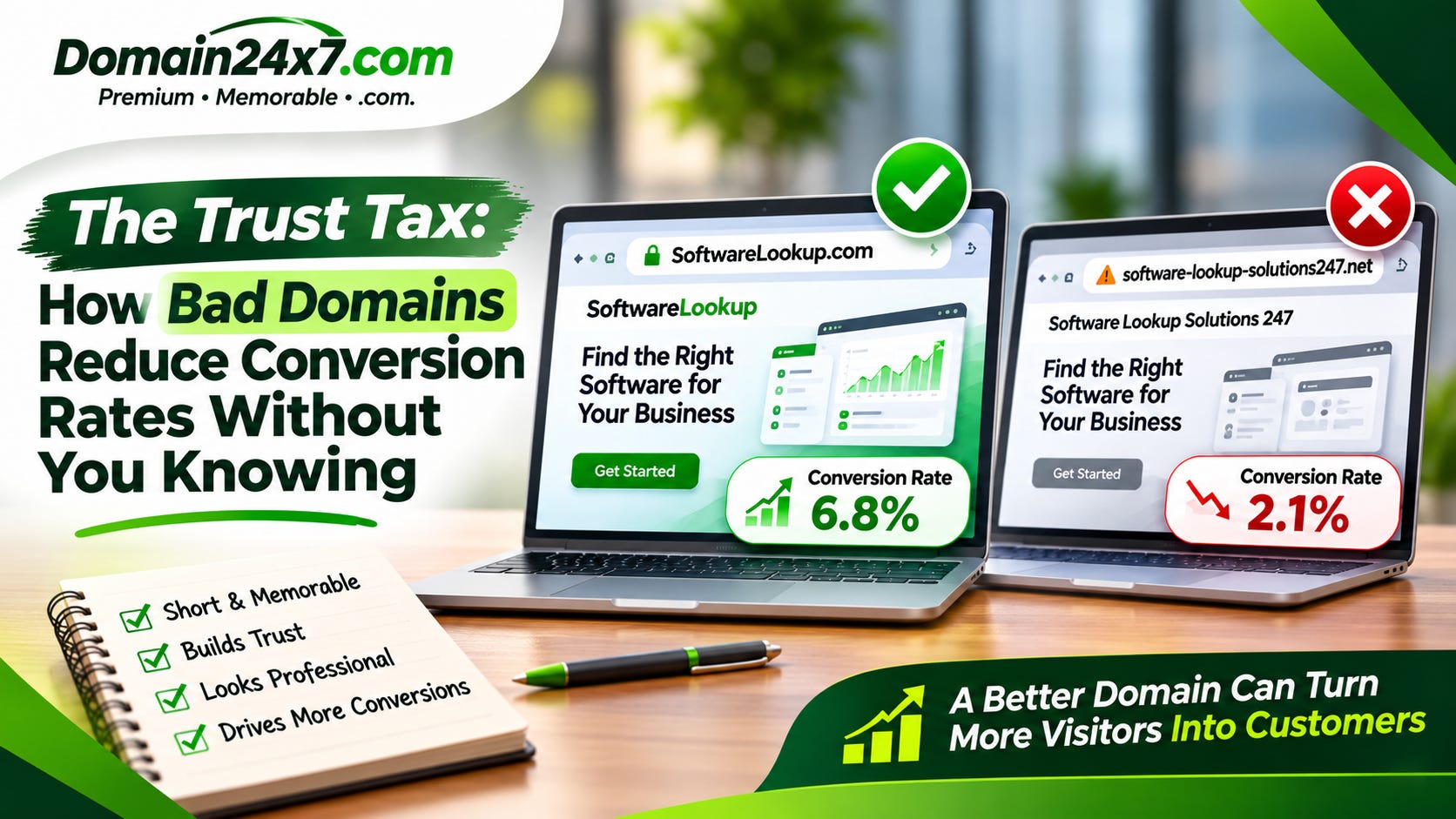
Your domain name is one of the first signals people encounter when discovering your business. It appears in search results, advertisements, email addresses, social media profiles, business cards, and customer recommendations.
A weak domain can introduce friction at every one of these touchpoints.
This is what we can call the Trust Tax: the additional hesitation, uncertainty, and credibility barrier a business creates through a poor domain name.
It is rarely measured directly, but its effects can influence how people perceive and interact with a brand.
1. First Impressions Happen Before the Website Loads
Most businesses spend considerable time improving their homepage design, choosing brand colors, writing sales copy, and optimizing their landing pages.
But they sometimes overlook the name customers must trust before visiting the website.
Consider these two hypothetical domain names:
BrightFinance.com
bright-finance-solutions247.net
Which one feels easier to remember? Which one looks more suitable for a professional financial business?
The difference is not necessarily about the quality of the companies behind them. It is about the initial impression created by their digital identities.
A professional domain can make a business easier to recognize and communicate. A complicated domain may create unnecessary questions.
Is this the official website?
Did I spell the address correctly?
Can I trust this business?
These small moments of uncertainty can become barriers to engagement.
2. Complicated Domains Create Friction
A domain name should make it easy for customers to find and remember your business.
Unfortunately, some businesses choose names that introduce unnecessary complexity.
Common examples include:
Excessively long domain names
Unnecessary hyphens and numbers
Unusual or confusing spellings
Difficult-to-pronounce words
Extensions that customers are unfamiliar with
Names that are easily confused with other businesses
Each issue can make the domain harder to communicate.
Think about a customer hearing your website address during a phone conversation. If they need to ask you to repeat it, clarify the spelling, or confirm the extension, your domain is creating additional friction.
The same problem can occur when someone sees your domain in an advertisement and tries to remember it later.
A strong domain reduces this friction by making the business easier to identify, recall, and revisit.
3. Your Domain Influences Email Credibility
Your domain does not only represent your website. It also becomes part of your business communication.
Consider the difference between:
The first email address presents a business using its own branded domain. The second relies on a generic email provider and a less distinctive identity.
A branded email address can contribute to a more consistent and professional presentation.
However, having a good domain does not automatically make an email trustworthy. Email authentication, including SPF, DKIM, and DMARC, sender reputation, and message quality also matter.
The important point is that your domain becomes part of the overall impression customers receive whenever they communicate with your business.
4. Weak Domains Can Make Advertising More Expensive
Businesses invest in Google Ads, Meta Ads, influencer campaigns, and other promotional channels to attract potential customers.
But what happens when an advertisement generates interest and the destination does not inspire confidence?
A potential customer might click, hesitate, and leave.
A domain name alone does not determine advertising performance. Ad relevance, targeting, landing-page experience, pricing, and product quality are much more significant factors.
Nevertheless, the domain is part of the customer journey.
For example, imagine an advertisement promoting a premium consulting service.
The advertisement looks professional, the offer is compelling, and the landing page is well designed. But the domain looks temporary, confusing, or unrelated to the business.
That inconsistency can create doubt.
A consistent brand identity helps reinforce the message customers see across advertisements, landing pages, and follow-up communications.
5. A Bad Domain Can Make a Good Business Look Smaller
Your business may have years of experience, a talented team, excellent customer service, and a strong product.
But customers cannot automatically see those things when they first encounter your brand.
They make initial judgments using the information available to them.
Your business name, logo, website, domain, email address, and online presence all contribute to that perception.
A weak domain can make an established business appear less polished than it actually is.
A suitable domain, on the other hand, can help a small startup establish a more professional and memorable identity from the beginning.
This does not mean an expensive domain guarantees credibility. It means the right domain can support the brand you are trying to build.
6. The Real Cost Is Not Always Visible in Analytics
One of the biggest problems with the Trust Tax is that businesses may never recognize it.
Google Analytics can show you:
Website visitors
Bounce and engagement rates
Conversion rates
Traffic sources
Landing-page performance
But these metrics do not directly tell you how many people hesitated because they found your domain confusing or unprofessional.
A visitor who decides not to click an advertisement, ignores an email, or forgets a website address may never appear in your analytics.
This makes domain-related trust friction difficult to isolate.
Instead of assuming your domain is reducing conversions, investigate whether it is creating unnecessary barriers.
Ask customers how they discovered your business. Review your brand presentation. Test whether people can easily remember and spell your domain. Compare customer responses to different brand presentations where practical.
Small improvements in clarity and consistency can make the customer journey easier.
7. What Makes a Domain Trustworthy?
There is no universal formula for a perfect domain, but several characteristics can help create a stronger digital identity.
Short and Memorable
A concise domain is generally easier to remember, communicate, and type.
Easy to Spell and Pronounce
Customers should not have to guess how to spell your business name or ask repeatedly for clarification.
Relevant to Your Brand
A domain should make sense for your business, industry, product, or intended brand positioning.
Professional Appearance
Avoid unnecessary numbers, confusing combinations, and excessive punctuation when they do not serve a clear branding purpose.
Consistent Across Channels
Use the same domain identity across your website, business email, marketing materials, and social media presence whenever possible.
Appropriate Extension
A .com domain can be a familiar and recognizable choice for businesses targeting broad or international audiences. Other extensions can also work when they fit the brand and audience.
The objective is not simply to own a short domain. It is to own a name that customers can recognize, remember, and associate with your business.
8. When Should a Business Upgrade Its Domain?
Not every business needs to change its domain.
If your current domain is memorable, relevant, established, and performing well, changing it simply for the sake of having a different name may create more problems than benefits.
However, a domain upgrade may be worth considering when:
Your current domain is difficult to remember or spell.
Your business has outgrown its original name.
Your domain does not reflect your current products or services.
You rely on a long or confusing web address.
Your brand is expanding into new markets.
You want a stronger identity for a new product, service, or business venture.
Before changing domains, consider the technical and SEO implications. Plan your redirects, update internal links, configure canonical URLs, maintain email authentication, and monitor Search Console performance.
A domain migration should be treated as a business project, not simply a name change.
9. Think of Your Domain as a Long-Term Business Asset
A domain name is more than a technical requirement for launching a website.
It becomes part of your brand identity.
You use it in advertisements, email campaigns, invoices, presentations, packaging, social media, and customer communications.
Over time, customers may begin associating that domain with your reputation, products, and services.
That is why choosing a domain deserves more attention than simply finding an available name.
Businesses should consider domain quality early in their branding process rather than treating it as an afterthought.
A suitable domain can support brand recognition, improve memorability, and create a consistent identity across marketing channels.
Final Thoughts: Stop Making Customers Work Harder to Trust You
Your domain name will not replace a good product, excellent customer service, or a well-designed website.
But it can either support those things or create unnecessary friction.
A confusing domain may make customers work harder to remember your business. An inconsistent domain may weaken your brand presentation. An unprofessional-looking address may introduce doubt at the wrong moment.
The Trust Tax is not always visible as a separate line in your marketing expenses. It can appear as hesitation, missed opportunities, weaker brand recall, and inconsistent customer experiences.
Before investing more money in advertising, redesigning your website, or launching another marketing campaign, take a moment to evaluate your domain.
Ask yourself one simple question:
If someone discovered my business for the first time today, would my domain make them more confident about choosing us?
Because your domain is often the first piece of your brand customers encounter.
Make sure it is helping your business, not holding it back.
Your next big brand starts with the right domain.
Explore brandable domain names for your next business or digital venture at Domain24x7.com.