


Choosing a domain name is one of the first important decisions you’ll make when building a business online. Your domain is more than a web address. It becomes part of your brand identity, influences how people discover your business, and provides a foundation for your website, email, and digital marketing.
Whether you’re launching a startup, opening an online store, building a professional services business, or expanding an established company, the right domain name can help you create a memorable online presence.
But with millions of registered domain names, how do you choose one that fits your business?
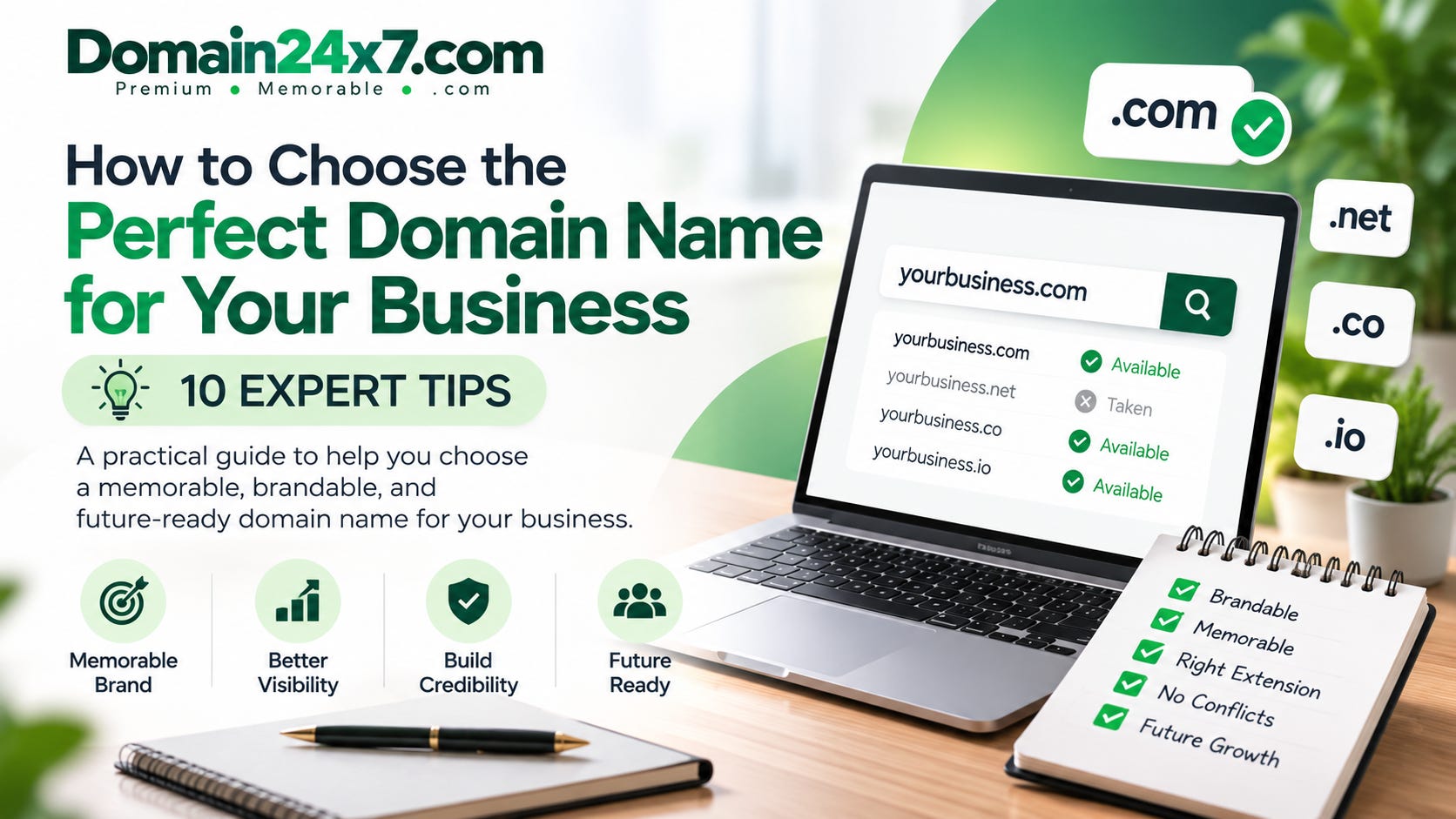
In this guide, we’ll cover 10 practical tips to help you choose a domain name that is memorable, brandable, and suitable for long-term growth.
Why Your Domain Name Matters
Your domain name is often one of the first things potential customers encounter when discovering your business online. It may appear in search results, advertisements, social media profiles, business cards, and email addresses.
A good domain name can help you:
Build brand recognition: Give customers a consistent name to associate with your business.
Improve memorability: Make it easier for people to remember and revisit your website.
Establish credibility: Present a professional identity across your website and business communications.
Support marketing: Use a consistent domain across advertising campaigns, social media, and email.
Create room for growth: Choose a name that can accommodate new products, services, and markets as your business develops.
A domain name alone will not guarantee higher search rankings, customer trust, or business success. However, choosing the right one can make your overall branding and marketing efforts more effective.
1. Choose a Domain Name That Is Easy to Remember
A memorable domain is easier for customers to recall when they want to revisit your website or recommend your business to someone else.
Think about how your domain sounds when spoken aloud. Can someone hear it once and type it correctly later?
Short, familiar words and straightforward combinations are often easier to remember than complicated phrases.
For example, a name such as BrightNest.com is relatively easy to say and spell. A long domain containing several words, unusual spellings, or unnecessary punctuation may be more difficult to communicate.
When evaluating a potential domain, ask yourself:
Is it easy to pronounce?
Can people spell it without assistance?
Is it easy to remember after hearing it once?
Would it work well in a conversation or advertisement?
Expert tip: Say the domain aloud to a few people without showing them the spelling. Then ask them to write it down. Their responses can reveal potential confusion before you commit to the name.
2. Prioritize a Strong .com Domain When Appropriate
The domain extension is the part that follows the name, such as .com, .net, or .org.
For many commercial businesses, .com remains a familiar and widely recognized choice. It can be especially suitable for companies targeting customers in the United States or serving an international audience.
A strong .com domain may offer several advantages:
Broad familiarity among internet users.
A straightforward fit for commercial brands.
Consistency across international marketing campaigns.
A recognizable format for business websites and email addresses.
However, .com is not the only legitimate choice. Country-code extensions can make sense for businesses focused on a particular country, while other extensions may suit specific industries or purposes.
The important thing is to choose an extension that fits your audience, brand, and business objectives.
If your preferred .com is already registered, consider whether another suitable name is available before settling for a confusing variation.
3. Make Your Domain Brandable, Not Just Descriptive
A descriptive domain explains what a business does. A brandable domain gives the business room to establish its own identity.
For example, a name such as BestAffordableWebDesignServicesOnline.com describes an offering but is long and difficult to use as a brand.
A shorter name such as PixelHarbor.com is more distinctive in style and may be easier to build a brand around, depending on the business and its audience.
A brandable domain can be particularly useful if you plan to expand your offerings over time.
Instead of restricting your identity to one product or service, consider whether the name could accommodate new categories, markets, and business models.
Look for names that are:
Distinctive and recognizable.
Easy to pronounce and spell.
Appropriate for your intended audience.
Flexible enough to support future growth.
Suitable for visual branding and marketing.
A strong domain does not need to describe every aspect of your business. It needs to provide a useful foundation for your brand.
4. Keep the Name Concise and Avoid Unnecessary Complexity
Shorter domains are often easier to type, communicate, and remember. Although there is no universal ideal length, simplicity is generally worth prioritizing.
Long domains can create practical problems. Customers may mistype them, forget parts of the name, or struggle to enter them correctly on mobile devices.
Consider avoiding:
Unnecessary words such as “the,” “best,” or “online” when they add little value.
Multiple hyphens.
Complicated abbreviations.
Repeated or confusing letter combinations.
Deliberately misspelled words that require explanation.
This does not mean every long domain is bad. A clear, meaningful two-word domain may work better than a short but confusing abbreviation.
The goal is clarity, not simply the lowest possible character count.
Choose the shortest name that communicates your brand effectively without sacrificing meaning or memorability.
5. Include Keywords Only When They Make Sense
Some business owners choose domains that contain keywords related to their products or services. For example, a company providing accounting services might consider a name that includes “accounting.”
A relevant keyword can help communicate what a business does, particularly when the name is otherwise clear and brandable.
However, avoid forcing keywords into a domain simply because you expect them to improve Google rankings. Search engines use many signals to determine relevance and ranking, and a keyword in a domain does not guarantee better visibility.
Compare these two approaches:
A clear, brandable name that is easy to remember.
A long, keyword-heavy domain designed primarily to include several search phrases.
The first may be more suitable for a business seeking to establish a distinctive identity.
If a keyword fits naturally into the name, it can be useful. If it makes the domain awkward or difficult to remember, prioritize the overall brand instead.
6. Check Trademark Conflicts Before Registering
Finding an available domain does not automatically mean you have the right to use it as a business name.
A domain can be available for registration while still creating potential trademark or brand-confusion issues.
Before committing to a name:
Search for businesses using the same or similar names.
Check relevant trademark databases in your target markets.
Review the names of competitors in your industry.
Search for similar spellings and pronunciations.
Consider getting professional legal advice if a meaningful conflict may exist.
Pay particular attention to names that resemble established brands, especially when the businesses operate in related industries.
Do not assume that adding a word, changing a letter, or choosing a different domain extension eliminates a potential conflict.
A little research before registration can help you avoid expensive rebranding and legal complications later.
7. Think About Your Future Business Plans
Your business may look different three or five years from now.
A freelancer may eventually build an agency. A local retailer may expand into ecommerce. A software company may introduce additional products or enter international markets.
A domain that is too narrowly defined may become restrictive as your business evolves.
For example, a name tied to a single city may be less suitable if you later serve customers nationwide. Similarly, a domain built around one product could become limiting if your company expands into several related categories.
Before choosing a name, consider:
Will it still fit if your business expands?
Can it accommodate additional products or services?
Will it make sense in different geographic markets?
Could it support a larger brand rather than just one offering?
You cannot predict every future change, but choosing a flexible domain can help you avoid unnecessary limitations.
8. Check Social Media and Business Name Availability
Your domain is one part of your online identity. Your social media profiles, business listings, and email addresses also contribute to brand consistency.
Before finalizing a domain, check whether suitable usernames are available on the social platforms relevant to your audience.
You should also consider whether the name is practical for business email addresses.
For example, a simple domain can support professional addresses such as [email protected] or [email protected].
Perfect username availability across every platform is not always necessary. However, major conflicts or highly inconsistent variations may make your brand harder to recognize.
Review these factors together:
Domain availability.
Relevant social media usernames.
Existing businesses with similar names.
Suitable business email addresses.
Consistency with your planned logo and branding.
A coordinated identity makes it easier for customers to recognize your business across different channels.
9. Decide Whether to Register a New Domain or Buy an Existing One
You generally have two routes when choosing a domain: register an available name or acquire one that someone else already owns.
Registering a new domain
This may be suitable when you have a flexible naming strategy and can find an available domain that meets your requirements.
Potential benefits include a relatively low initial registration cost and the ability to explore many naming combinations.
However, your preferred name may already be taken, particularly if you want a short, common, or highly brandable .com.
Acquiring an existing domain
An already-registered domain may offer a name that better matches your brand or business objectives.
Existing domains can include short names, memorable phrases, relevant keywords, and distinctive brandable combinations.
However, the asking price may be higher than a standard registration fee. You should also investigate the domain’s history, ownership, potential trademark concerns, and any relevant technical or reputation issues.
Before acquiring a domain, confirm:
The seller has the authority to transfer it.
The price fits your budget and business case.
The domain’s history has been reviewed.
The name does not create an avoidable legal conflict.
The transfer and payment process is appropriate and secure.
An existing domain is not automatically better than a newly registered one. The right choice depends on your requirements, budget, and long-term plans.
10. Evaluate the Domain as a Business Asset
A domain should not be evaluated only by its registration price or length.
If you are choosing a name for a business, consider how well it supports your brand, audience, and marketing activities.
If you are acquiring a domain as an investment, the evaluation is different. You may also need to consider potential buyer demand, comparable sales, naming trends, commercial applications, and the time and cost involved in reselling it.
For business owners, useful questions include:
Does the name fit our positioning?
Will our target customers understand or remember it?
Does it support our intended products and services?
Is the cost reasonable relative to our business plans?
Could it create avoidable legal or branding issues?
A domain does not guarantee future revenue or resale value. Treat it as a strategic decision and evaluate it according to its intended use.
Domain Name Checklist: Before You Make a Decision
Use this checklist to compare your shortlisted domains before registering or acquiring one.
Easy to pronounce and spell.
Memorable and reasonably concise.
Suitable for your business and target audience.
Flexible enough to support future growth.
Appropriate domain extension for your market.
No obvious trademark or brand-confusion concerns.
Relevant social media usernames reviewed.
Existing domain history checked if acquiring a registered domain.
Price and renewal costs fit your budget.
Domain registrar or seller is reputable.
You do not need a perfect score on every subjective criterion. Use the checklist to identify weaknesses, compare alternatives, and make a more informed decision.
Final Thoughts: Choose a Domain That Supports Your Brand
The perfect domain name is not necessarily the shortest, cheapest, or most keyword-rich option.
It is the name that fits your business, communicates effectively with your audience, and gives your brand a strong foundation for the future.
Start by defining your business goals and identifying the qualities that matter most. Shortlist several names, test their memorability, check for potential conflicts, and compare available registration or acquisition options.
If your preferred name is already registered, do not rush into an awkward alternative. Explore other brandable options and consider whether acquiring an existing domain makes sense for your business.
A thoughtful domain decision can support your branding and marketing for years to come.
Find Your Next Business Domain With Domain24x7
At Domain24x7, we help entrepreneurs and businesses explore domain names for their next online venture.
Whether you are launching a startup, building an ecommerce store, developing a new product, or refreshing your brand, the right domain is an important place to start.
Explore available domain names at Domain24x7.com and find a name that fits your business ambitions.